By Elliott King
Published 6 October 2026
In November two thousand and sixteen I stood up at the Institute of Directors in London and told the story of the previous twenty years of digital from the inside, because I had been in San Francisco for the part everybody has heard about and nobody was there for. This is that talk, laid out moment by moment: twelve passages, each one headed by the question it answers, each with the exact second it happens so you can hear me say it.
I have edited the quotations for sense, which is what any newspaper does with speech, and left the receipt attached to every one of them. Follow the link beside a quotation and you land on the second it starts.
What was the dot com boom actually like?
This is the boom described from inside it, by one of the programmers building the platforms. The detail worth keeping is the scale of what was being built, and on what evidence.
"It was nineteen ninety nine in San Francisco, and you would drive anywhere in California and see huge billboards talking about gardening dot com, anything you like dot com. There were billions of dollars of investment going into these companies, and programmers like me were developing the infrastructure the investors believed would take all of retail commerce online almost overnight."
Watch this moment, 0:51
The belief was that retail commerce would move online almost overnight. It did move, but not on that timetable, and the gap between the two is what happened next.
Why did dot com start-ups fail?
Competition for engineers was severe enough to make paper millionaires of people in their twenties. The assumption underneath all of it fits in a single sentence.
"There was so much competition for programmers that start-up companies were giving vested share options, so friends of mine in their twenties were literally paper millionaires. The concept was that if we build it, the consumers are going to come. But they were a bit too quick, because although the programmers in Silicon Valley were connected and using the internet, the wider world was not quite there yet."
Watch this moment, 1:55
The sentence was wrong about timing rather than about direction, which is the most expensive kind of wrong a market can be.
What happened when the dot com bubble burst?
The collapse is usually told through valuations. Told from inside, it is told through people, and it happened very fast.
"Your company, or in this case an entire industry, went bust, and it was the dot com bubble bursting. I had many hundreds of friends working in that sector, literally paper millionaires one day, and almost the next day the companies had gone bust, the paper was worthless, and they were on the plane back home. But there were survivors, and there were companies that thrived out of the ashes."
Watch this moment, 2:50
The survivors are the interesting part, and the rest of the talk is about what they had in common.
Why is search advertising so profitable?
This is the structural point of the talk, and it is about position rather than about product.
"Having controlled the market, so they supply ninety percent of the market, they then did something that was genius. Very early on they built an automated marketplace to sell access to the market that they controlled. So they are the supplier, but they are also the middle-man to the buyers, which is basically ninety percent of the Western world. A highly profitable business."
Watch this moment, 5:10
Owning the audience and owning the auction that reaches it are two different businesses. Holding both at once is what makes the economics work.
What was Amazon's early strategy?
Search made it possible for people to find an online shop. That is the precondition for everything that follows.
"Because Google was successful and suddenly there was a way to effectively market products and services, it really allowed e-commerce to work. Jeff Bezos' strategy was to dominate a single market sector for e-commerce and to perfect customer service and delivery. Although they were still loss making, once digital marketing started to work they became highly profitable, because they had invested so much in that single sector, books."
Watch this moment, 5:46
The sequence matters more than the ambition: one category won completely, and only then the move into everything else.
Why was the first iPhone so important?
Apple had been the loser of the previous decade. The return is the part everyone remembers; the mechanism behind it is the part worth studying.
"This is where Apple make a comeback. They lost out quite badly in the nineties, and Steve Jobs was actually fired from Apple in the late nineties, but they re-hired him. In two thousand and seven he released the iPhone one, and it was game changing because it made mobile properly accessible. The two technologies that underpin the iPhone had been around for a long time."
Watch this moment, 7:17
Neither technology inside the phone was new. What was new was the decision to put them together and make the result usable.
What do successful technology businesses have in common?
Before the closing advice, the talk sets the survivors side by side to see what they share.
"Amstrad, Lord Sugar, a classic businessman: he saw a trend, that computers were going to be interesting to consumers. He moved very quickly, was very early to the market, and was able to realise success off the back of doing that. What Bill Gates did was look at an existing trend and look at where it was going to lead."
Watch this moment, 8:29
Two different bets are on the table: being first to a trend, and being right about where it ends up.
How did Microsoft get its software to market?
The bet was on where an existing trend would lead rather than on the trend itself: more computers sold would mean software decided the winner.
"In the end software was going to be the differentiator. His tactic for getting there was to give the product away to the company that had the largest access to market. Microsoft were a very small company and piggybacked on IBM to reach that market, which was an investment in his own vision. Once people wanted more software platforms, Microsoft were able to profit and control the market."
Watch this moment, 9:06
Giving the product away looks like a concession. It was a distribution strategy, and it bought access that a small company could not otherwise buy.
How does Google actually make its money?
Winning the audience was the first move. Turning that audience into a market was the second, and it is the one that made the money.
"To be fair, they were in the right place at the right time, because they were able to become a darling of the tech community in Silicon Valley, and they grew out of that niche marketplace. The way they monetised it was to build an automatic platform that effectively sold the supply of a market they already controlled. That marketplace technology was genius, because it is a profit machine."
Watch this moment, 9:49
A business that both supplies a market and sells entry to it occupies an unusual position, and the talk does not pretend otherwise.
Why does Google invest in loss making projects?
Having described the position Google holds, the talk turns to what that position lets a company do next.
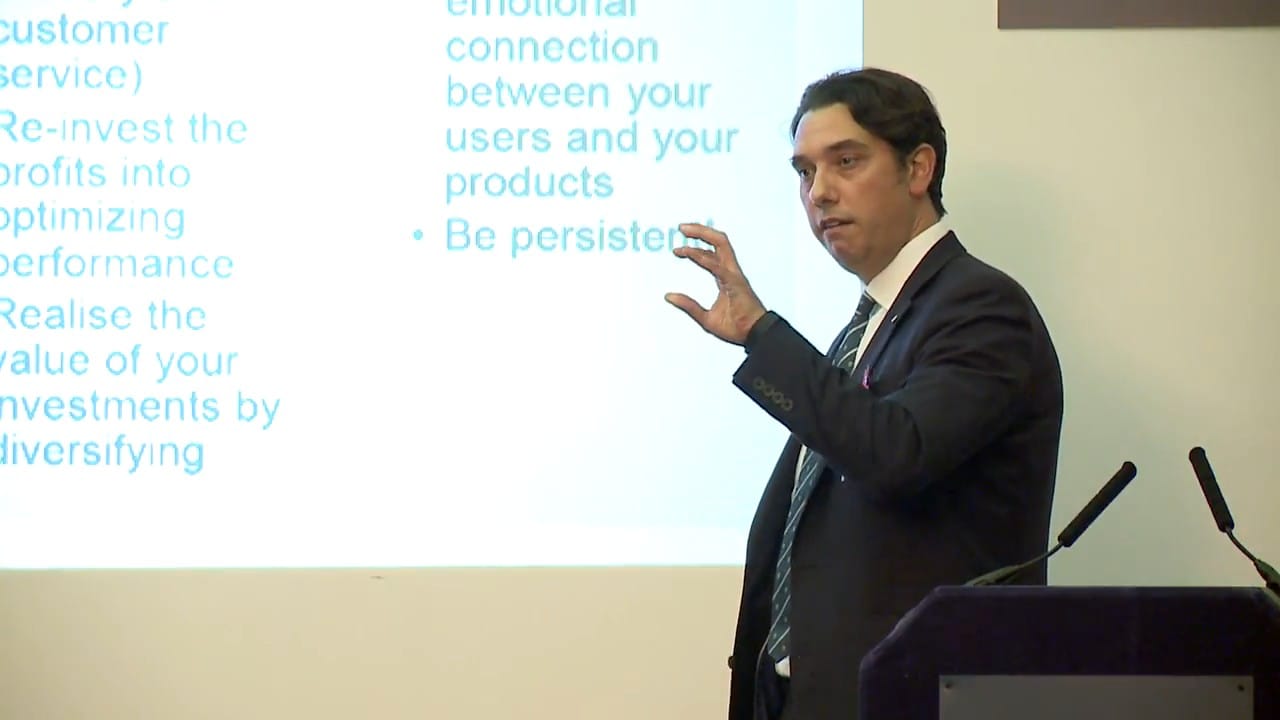
"You think about someone in Google headquarters just pushing a button up and down, deciding how much profit they want to make. A company making that much profit can diversify, and you see Google doing all sorts of other things, the vast majority of which are loss making. Why pay tax on your profits when you can invest in all these other great things?"
Watch this moment, 10:24
The observation is offered without much complaint. The talk treats it as a rational consequence of the structure it has just described.
What can a business learn from Apple?
The lesson taken from Apple here is not a technical one at all.
"Believe in your big vision, use design, make the thing beautiful, and then consumers are going to want it. Apple have always been focused on the consumer market, because they have a big vision that they want to spread to everyone. He was also very persistent. He was fired by Apple, he was in the dark for a few years, he came back, and arguably he changed the world."
Watch this moment, 11:23
Persistence is doing a great deal of work in this account: fired, years out of the light, then back.
How should a business move in the digital age?
These are the lessons drawn at the close of the talk, after walking through the companies that survived the crash and the ones that did not.
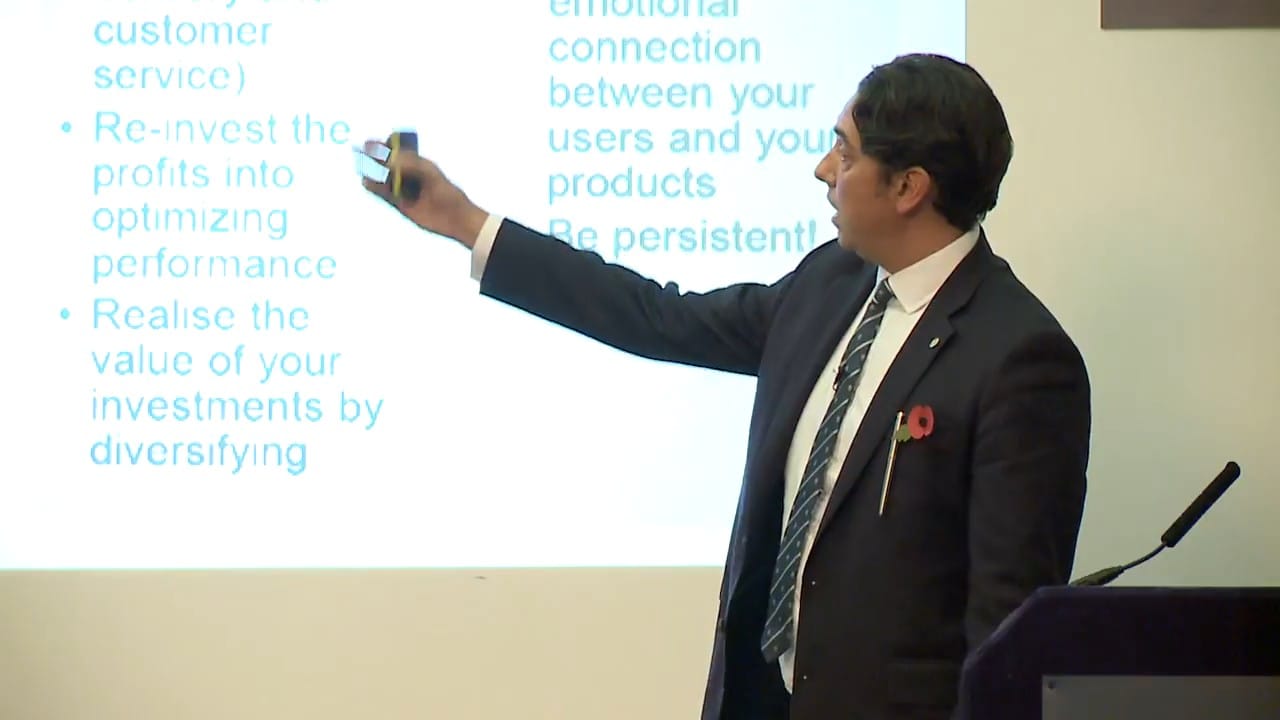
"One of the main things you need to do to take advantage of the digital age is to plan, but do it quickly. You need to differentiate. You need to be bold, and you need to be decisive and quick. The adage in Silicon Valley is that it does not matter if you fail, as long as you learn the lessons and adapt quickly."
Watch this moment, 11:55
It is advice about speed rather than certainty, and it comes from someone who watched an entire industry get the timing wrong.
Where can you watch the whole talk?
My own write-up of the event, including the panel I chaired afterwards, is here on this site. If you would rather read the story than the index, I have told it as one continuous piece.
Why am I publishing a talk from two thousand and sixteen?
Because the argument in it has not dated, and because I keep meeting people who are making the nineteen ninety nine mistake with a different technology. Building for a demand that has not arrived is the most expensive error available, and it looks like ambition right up until the moment it looks like a bubble. I have written about the same pattern from the other end, in what survives a platform shift and in why a live conversation outranks generated copy.
These days I am a Managing Partner in the Integrated Marketing division at FINN Partners and work as an AI visibility expert. Aleksandra and I set out the strategy side of all this at greater length in Marketing Wins. If any of it is on your roadmap, my door is open.