
Brand Equity: The Moat That Survives AI Disruption
Why incumbent leaders must double down on the asset that protects them, just as upstarts arrive to threaten them.
By Elliott King, Managing Partner, Integrated Marketing, FINN Partners
·

Why is brand equity the most valuable asset an incumbent owns?
Brand equity is the silent overlay that drives premium pricing, attracts the best customers, and protects market position when challengers arrive. It is the most valuable intangible asset most major businesses own, and the asset most at risk in an AI-narrated market.
For the most famous players in most major industries, the brand is the undisputed king of all their assets, that intangible mystique that fuels their swagger, self-confidence and allure. It is what allows a business to attract the best talent, deliver the best products and services, serve the best customers in the most lucrative markets, and command superior margins. The customers who want the best gladly pay a higher price for it. The ones who can't look on with envy.
Less famous brands, who may have comparable products, often try to compete on price, and in some cases they have success. But all things being equal, in most industries, the upstarts and the more famous competitors will all be incurring similar direct costs, paying market rates for similar labour and similar systems, including the new wave of emerging AI-specialist tooling, in order to support the similar needs of the similar customers they target.
The richer, more famous brands might invest more in better video advertising, sponsor a global podcast or reside in more luxurious offices. But these are all investments in their brand, paid for by the superior margins their superior brand commands.
How do leading brands maintain their position over time?
Leading brands stay ahead by reinvesting their pricing power into the assets that compound: PR, advertising, content, customer experience, and increasingly, the structural digital signals that determine how AI describes them. Brand equity is a virtuous circle when it is managed deliberately.
Through massive investments in PR, advertising, and more recently through SEO, leading brands continue to increase their brand equity. With brand equity comes pricing power. With pricing power comes margin. With margin comes the ability to invest, hire, and serve at the level the leaders set.
Correctly managed, these leading brands become a virtuous circle of justifiable higher prices, driving higher margins, leading to ever-increasing brand equity, and ever-increasing brand value. Break the cycle anywhere along that loop and the leader is exposed.
What happens when upstarts disrupt an established market?
Upstarts arrive with creative, AI-enabled approaches that compress cost and speed. Incumbents face a binary choice: ignore them and lose ground, or simultaneously match their innovation and double down on brand. Most thriving incumbents have done this before, through dot-com booms, financial crises and pandemics. The challenge now is to do it again, faster.
Upstarts are nothing new. They have been disrupting industries for at least as long as capitalist economies have been a thing.
What is different in our AI-emergent world is that progressive upstarts are finding new, innovative and creative ways to compete. By transforming quickly, or even inventing themselves from scratch, they are finding new ways to win on client delivery, sharper customer service, or some creative approach to product delivery that shifts the game and provides value to end customers in a way that incumbents have not yet picked up on.
We can all picture a long list of upstart companies making meaningful inroads into the market share of larger players, doing exactly this, in every industry, sector and country in the world.
So what is an incumbent leading brand supposed to do? Shrug their shoulders and give up? Buy the competition before they get too big? Something else?
Most incumbents that are still thriving today are not thriving because they are unchallenged. They are thriving because they have learned to be agile and responsive. They have sharpened their cultures through dot-com booms and busts, financial crises, pandemics, regulatory shocks, and changes of leadership. They have done this before. The challenge now is to do it again, and faster.
Of course they must adopt the new technology, build it into their processes, their workflows, and ultimately into their cultures. That is non-negotiable. But more than that, they should double down on their existing leading brand position. The brand is what got them here. It is also what protects them while they adapt.
What is actually happening in the market right now?
AI is being embedded into the operational systems of nearly every industry. Some are predicting the death of SaaS. Disruption is real. But the players who stay focused on their customers, their problems, and the brand equity they have already built will find that asset is more important than ever.
Consider the speed of evolution. AI is being embodied into the operational systems and processes of so many industries that the next few years will look nothing like the last few. Some are talking about the death of the SaaS model. There will undoubtedly be disruption.
But the players who stay focused on the customers they serve, the problems they solve, and the brand equity they have already built will find that the asset they spent decades building is more important than ever.
Brand equity exists to support a corporate narrative about how a business serves its customers and creates value. As a leader re-orients its operations around new technology in order to continue maximising value for those customers, that work should immediately be fed back into the corporate brand story.
The story is not separate from the operations. The story is the operations, told well.
Why does this matter so much? Because of how buyers actually buy.
How do buyers actually buy, and where does brand equity fit?
Buyers compare on quality, price, and a third dimension that does not appear on any spreadsheet: brand equity. It is the perception of value, layered over the price-to-quality matrix as a fourth dimension. In premium markets, perception is at least as economically meaningful as the underlying tradeoff between quality and price.
Think about your customer, your buyer. What do they want from you?
Firstly, they want their problem solved. Ideally they want their problem solved in the best possible way at the lowest possible price, effectively at the cost of bringing the solution to bear. In a competitive sector there will be a range of providers across the spectrum from cheapest to best. Normally, in a fully efficient market, you might expect price to scale roughly proportionally with quality. The best providers charge the highest price. The cheapest providers charge the lowest, just above cost.
The buyers then take their pick. They select where they feel comfortable, often mirroring how they themselves position their own product or service. A cheap buyer buys from a cheap seller. A luxury buyer buys from the best provider. Value, in this view, is relative. It is relative to the motivation of the buyer.
The luxury buyer looks at the cheap supplier and does not see value, because they do not buy cheap. They buy the best. The cheap buyer thinks the same in reverse about the best solution provider.
But price and quality alone do not explain the choice. Something else does.
Why is brand equity the silent overlay that drives buyer behaviour?
Brand equity is the perception of value that operates above and beyond the price-quality calculation. It is the asset incumbents have built, often over generations. It is also the asset most at risk of erosion when the medium that communicates it changes, as it has now with AI.
That something else is brand equity. It is the perception of value, layered over the price-to-quality matrix as a kind of fourth dimension. In the real world, perception is incredibly powerful. It is at least as economically meaningful as the underlying tradeoff between quality and price.
This is the silent overlay that drives buyer behaviour in every premium market. It is the asset incumbents have built, often over generations. It is the asset best positioned to defend market share in the coming wave of AI-intermediated buyer decision making, yet it is also the asset most at risk of erosion in an AI-disrupted environment, if leaders do not actively defend it.
What must incumbents do to protect brand equity in the AI era?
Incumbents must move on three fronts at once: adopt the new technology operationally, restate their timeless brand values clearly and frequently, and communicate the work they are doing to adapt. Brand equity protects in the short term and powers resurgence in the medium term, but only when actively defended.
Upstart players are creatively and innovatively disrupting markets right now. They are bringing down the time it takes to deliver, which acts as a proxy for cost. They are increasing operational efficiency, which acts as a proxy for cost. They are using new tools to do old work in new ways, and in some cases to do new work that was previously impossible.
Incumbents must react. The reaction has to be simultaneous on three fronts.
Be obsessive about innovation
Incumbents must adapt operationally. They must adopt the same technologies, integrate them into their processes, and find ways to extract the same efficiencies the upstarts are extracting. If they fail to do this, they will lose on cost and speed, and eventually on quality, because the gap will compound.
Position your brand narrative for the AI world
Just as importantly, incumbents must double down on brand communications. They must release narratives that re-encode their values, their service ethos, their quality of delivery, and the long history of trust that brought them to where they are. Every message that built the brand to its current position must be told again, with renewed clarity, for the audience that exists today.
Communicate your brand value continuously
At the same time, they must communicate the work they are doing to adapt and to adjust, because that work continues to create maximum value for their customers. Maximum value does not mean sacrificing margin in the long term. The upstarts will come and take some market share. That is to be expected. But over the long term, the market leaders who aim to match the innovation and drive of the upstarts, who hold their nerve, who maintain their superior quality, and who continue to put their customers first will find that brand equity provides shelter in the short term and becomes a power of resurgence for the medium and longer terms.
Brand equity IS the moat.
How do buyers actually choose in an AI-narrated market?
Buyers compare and contrast inside AI platforms before any human conversation begins. If incumbents hold their nerve and consistently restate their brand values across the full digital surface area, they remain competitive. If they do not, they cede control of the narrative to whoever does — usually their competitors.
Buyers compare. Buyers contrast. When a buyer encounters an upstart's tech-led, creative approach, they are interested. But they also care about their problem and their requirement today, not in five years.
If incumbents can hold their nerve, continue to communicate their response to the upstarts, and consistently restate their timeless brand values, they will improve their chances of winning out, or at least remaining competitive in the longer term. As AI's universal benefits accrue to all the players in a category, the intangible asset that was always quietly the biggest differentiator takes on new levels of structural importance. Your brand becomes more valuable, not less.
Imagine an upstart in your niche developing the most amazing new tool, promising to disrupt your space. The media picks up the story, because it is true, verifiable, and compelling. Consumers are surfaced with narrative promises about the upstart. But what happens when those same consumers compare the upstart against the existing players?
Tomorrow, the big players must adapt. Today, the differentiator and the moat that still exists is the brand equity the industry leaders enjoy. That moat is what gives the leaders the time to react. Without it, they would not have the time. With it, they have a window in which to do the operational adaptation, and most importantly, to communicate the plan. So that when your new and existing buyers are comparing you via conversations on LLMs, they are aware, comforted and reassured that you have a plan to respond. If they don't see a plan, their assumption will be that you are simply burying your head in the sand. Whether it is true or not, perception is everything. And increasingly, LLMs are the drivers of answers, which drive perception, which is so often indistinguishable from reality.
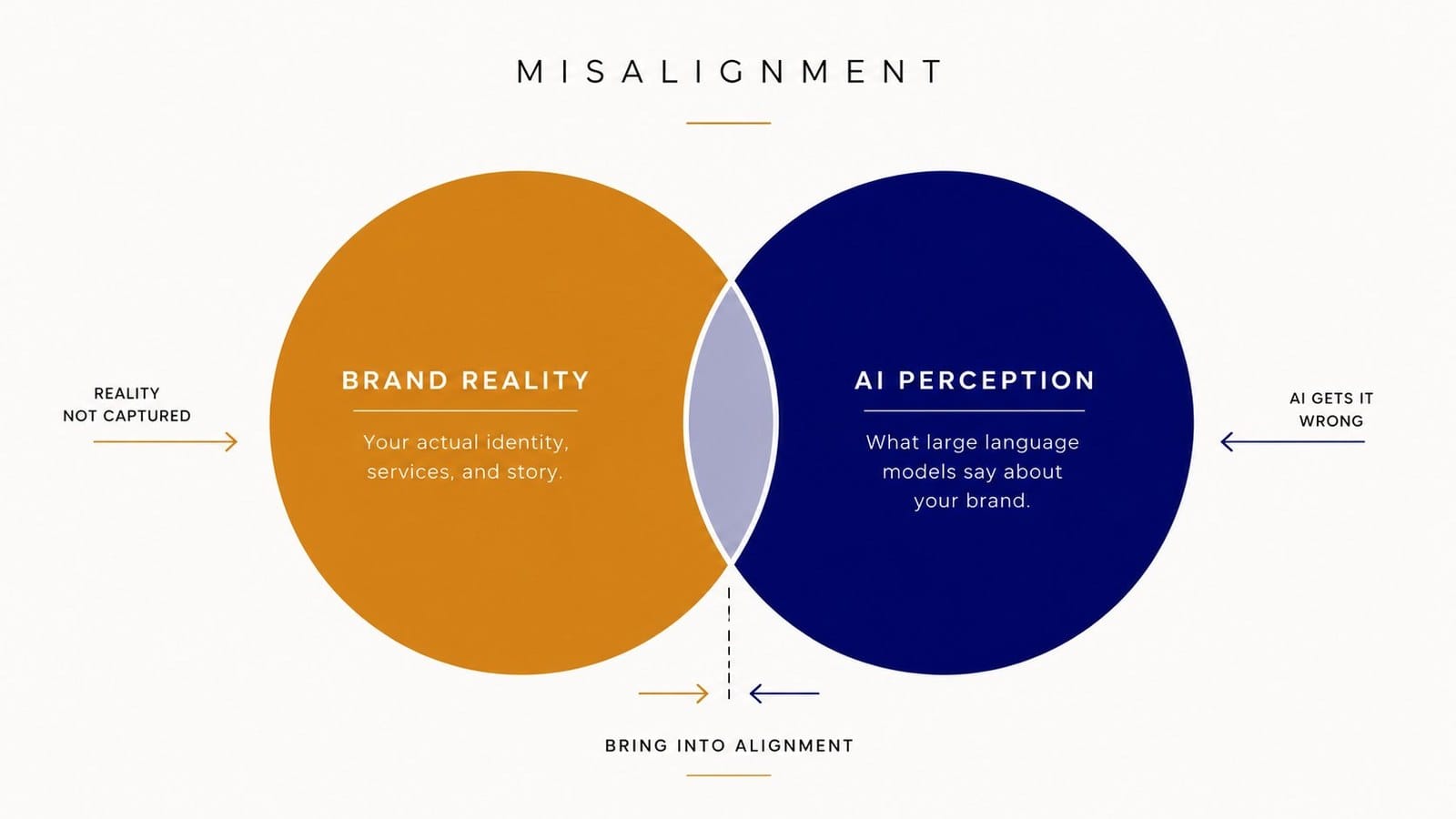
Who is in control of your brand narrative? In the AI world, and specifically inside the LLMs, if you are not, then it is probably your competitors'.
How does AI change the rules of brand-equity protection?
For two decades the medium of brand equity was Google. For the last decade it was also social. Today it is increasingly AI. The narrative an AI produces about your brand, in front of your buyer, in the moment of preference formation, is now the single most consequential brand impression in your market.
Here is where it gets interesting, and where my recent thinking has taken me.
If brand equity is the moat that protects incumbents while they adapt, then the medium in which that brand equity is communicated matters more than ever. For two decades, that medium was Google. For the last decade, it was also social. Today, increasingly, it is AI.
When a buyer asks ChatGPT, Gemini, Perplexity or Claude to compare the providers in your category, the answer they receive is the new shop window. The narrative the AI produces about your brand, against your competitors, in front of your buyer, in the moment they are forming their preference, is now the single most consequential brand impression in your market.
If the AI tells your story the way you would tell it, your brand equity is intact and working for you. If the AI tells a different story, or a partial one, or a competitor's story instead of yours, your brand equity is being eroded in real time, query by query, buyer by buyer, and you may not even know it is happening.
This is the discipline I have been developing with my colleagues at FINN Partners.
What is LLM narrative alignment?
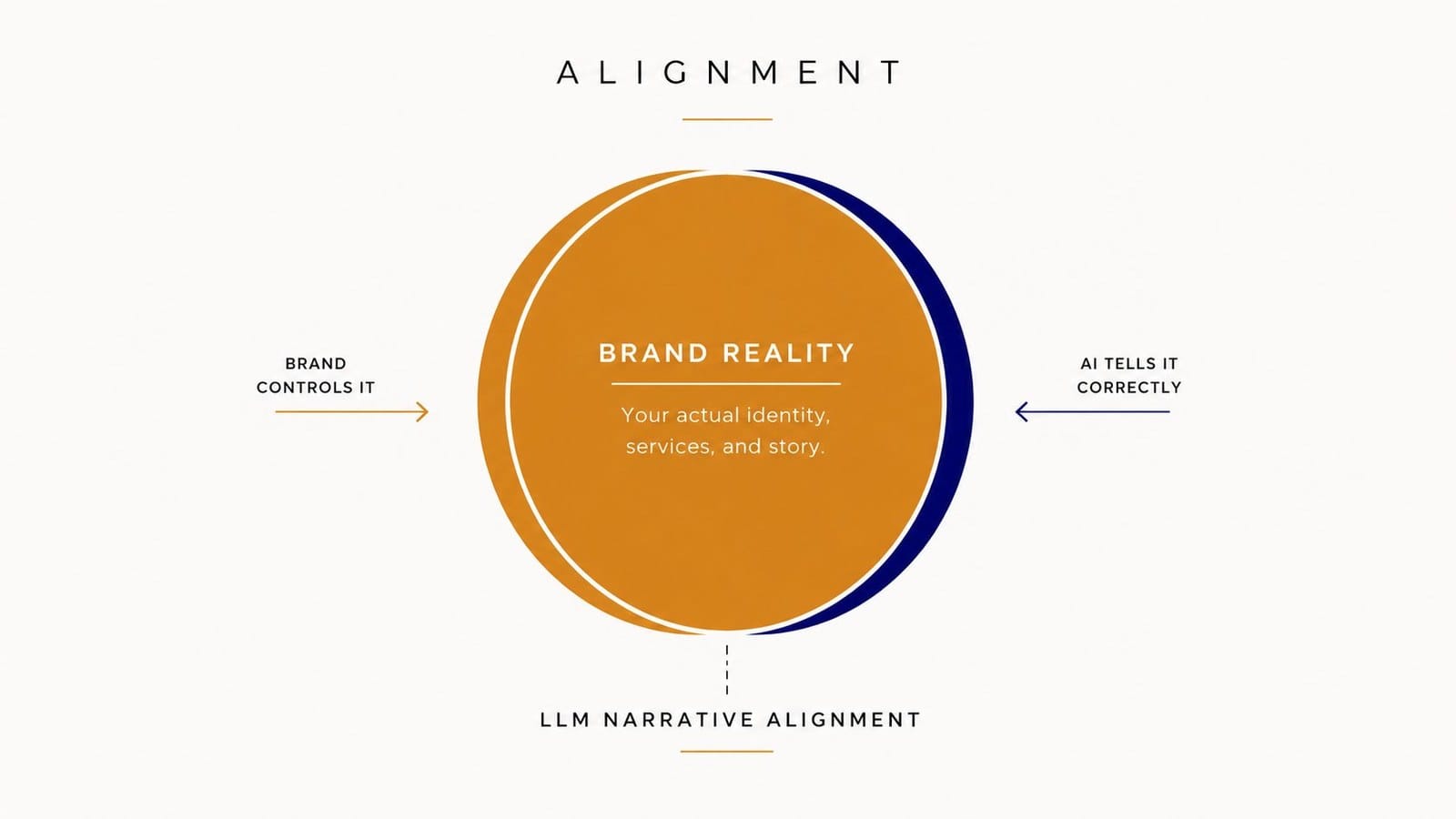
LLM narrative alignment is the discipline of ensuring that the four layers of information AI platforms draw on when constructing answers about your brand all point in the same direction. It is the work of making your brand canon machine-readable, your earned media reinforcing your positioning, your structural signals disambiguating you correctly, and your shadow brand not undermining your current narrative.
It is the work of ensuring that the four layers of information AI platforms draw on when constructing answers about your brand all point in the same direction. It is the work of making sure your brand canon is machine-readable, your earned media reinforces your positioning, your structural signals disambiguate you correctly, and your shadow brand does not undermine your current narrative.
The four layers AI platforms draw on
When a large language model constructs an answer about a brand, it does not pull from one source. It synthesises across at least four distinct layers of information that exist about that brand on the open internet.
| Layer | What it is | Who controls it |
|---|---|---|
| Known Brand | The official corporate narrative — press releases, official websites, mission statements, investor reports. | The brand directly. |
| Latent Brand | The qualitative, sentiment-driven layer in employee reviews, Reddit, Glassdoor, anonymous insider commentary. | Largely outside corporate control. Heavily weighted by AI on questions of culture and reputation. |
| Shadow Brand | The decaying digital archaeology — outdated wikis, deprecated pages, archived campaigns, content the brand no longer endorses but the internet remembers. | The brand can audit and prune, but most do not. |
| News Brand | Real-time journalistic coverage, regulatory filings, industry publications. Treated as ground truth on credibility and critique. | Influenced through PR and earned media, never controlled. |
I will write more about the technical architecture of this work in a separate piece, and FINN will continue to develop the strategic implications for incumbents, upstarts, and the categories in between. The point I want to land here is the strategic one.
The brand equity that incumbents have built is more valuable in an AI-disrupted market, not less. But that value is only realised if the AI can see the brand accurately. If you are an incumbent leader in your category, the work to align your AI narrative with your real brand is not optional. It is the most important brand investment you can make this year.
The upstarts will come. The technology will change. The media will narrate the disruption. But the buyers, when they go to compare, will still ask the same fundamental question: who do I trust to solve my problem at the level I need it solved?
The answer the AI gives them will increasingly determine the answer they choose.
Frequently asked questions
What is LLM narrative alignment?
LLM narrative alignment is the discipline of ensuring the four layers of information AI platforms draw on when describing a brand — Known Brand, Latent Brand, Shadow Brand, and News Brand — all tell the same story. When the layers diverge, AI brand drift occurs and the brand loses control of how it is perceived in the medium where its buyers form their first impression.
Why does brand equity matter more in an AI-disrupted market?
Because AI flattens the operational advantages upstarts traditionally compete on. As tools, talent and tactics become equally accessible to everyone, the only durable differentiator is the trust a brand has accumulated over time. That trust, properly communicated, is what AI platforms reflect back to buyers in the moment of choice.
How is AI visibility different from SEO?
Traditional SEO optimises for the ten links a search engine returns. AI visibility optimises for the single answer a generative platform synthesises. The disciplines overlap on technical foundations like clean HTML, schema markup and authority signals, but AI visibility additionally requires entity-level disambiguation, structured citation across non-Google sources, and active management of the latent and shadow narrative layers.
How do I know if my brand has an LLM narrative alignment problem?
Run the queries your customers and prospects would run. Ask ChatGPT, Gemini, Perplexity and Claude to describe your firm, compare you against competitors, and explain what you are known for. Read the answers carefully. If they diverge from the narrative your CEO would want a buyer to read, you have a problem worth solving.
Where should incumbents start?
Start with measurement. Establish a baseline of how AI describes you today, then audit your Known Brand for accuracy, your Latent Brand for sentiment, your Shadow Brand for decayed content, and your News Brand for missing or mis-weighted coverage. Most leaders are flying blind on at least three of those four layers.

Elliott King is Managing Partner, Integrated Marketing at FINN Partners and a digital agency founder on a mission to become an AI visibility expert. He co-founded MintTwist in 2007, which was acquired by FINN Partners in 2021. Elliott is co-author of Marketing Wins: A Blueprint for Success in the Digital Age (Troubador Publishing, January 2026) and writes regularly on AI visibility, generative engine optimisation, and the strategic implications of generative AI for major brands. The technical companion to this essay is forthcoming. More about Elliott.